
Executive Summary:
The following Kairos Research report will cover a number of potential design choices for the Fogo Chain, across:
Multi-Local Consensus: Using the “Follow the Sun” method to utilize three regions across 8-hour epochs (Asia, Europe/US overlap, US) with a plan that allows for geographic diversification in the future
Validator set: Require high-performance hardware and prior Solana/Hyperliquid experience; foundation stake split equally at launch across 7 operators with a governance focused plan to include additional value-add participants as the network matures
Incentives: Fix validator commission at 10% initially to avoid fee races; penalize missed slots and reward geo-diverse, high-performing operators. Create a plan for validators to eventually lower their commissions, once a certain percentage of the total supply is staked
Economics: Adopt a fast-decay inflation schedule (6% → 4% → 2% in 3 years, with option to cut to 1%)
Governance: Formalize Fogo Improvement Proposals (FIPs) with transparent, stake-weighted voting and multisig council enforcement for validator accountability
Introduction
The following report is written by Kairos Research with the purpose of exploring potential validator design choices on the Fogo Network. We will explore the economic, technological & governance perspective of validators using the best practices from other networks and novel ideas that could be explored with further consideration. We will also include our personal recommendations on the right path forward for various parameters which we believe provide the optimal way to promote economic sustainability, token value accrual, and decentralization while maintaining performance.
Fogo contributes three novel innovations to the highly performant blockchain network space:
A unified client implementation based on pure Firedancer, unlocking performance levels unattainable by networks with slower clients, including Solana itself.
Multi-local consensus with dynamic colocation, achieving block times and latencies far below those of any major blockchain.
A validator set that incentivizes high performance and deters predatory behavior at the validator level.
Validator Requirements
Below are some potential outlines for the initial Fogo validator set, including the minimum & recommended technical specs (Solana Frankendancer & Hyperliquid) and operational standards for validators. We used a combination of the Fogo testnet requirements as well as outlines from Firedancer and Hyperliquid. Another more in depth outline from Helius can be found here.
Minimum
24-Core AMD or Intel CPU @ > 3.5Ghz w/ AVX512 support
128GB of RAM: Proven to work on Fogo Testnet
4TB PCI Gen3 NVME SSD (High TBW)
Recommended
32-Core CPU @ >3GHz with AVX512 support
512GB RAM with ECC memory
Same capacity with separate disks for Accounts and Ledger
1 Gigabit/s Network Bandwidth
Being overly ambitious with your hardware can also lead to performance degradation, as seen on Solana so setting minimum and recommended specs seems to be an effective way to maintain consistency across the set.
Recommended validator experience criteria (incl. Firedancer)
Running a validator on high-performance networks such as Solana, Hyperliquid, Monad
Experience with DoubleZero and Frankendancer
We have identified a shortlist of validators eligible for the initial foundation delegation
Given Fogo will be the highest-performing blockchain amongst all its peers with 40ms blocktimes, we believe the network should maintain an emphasis and community mindset of builders who are actively seeking to push the limit of their hardware and deliver the fastest possible experience for users on Fogo. We believe Solana’s north star of “increasing bandwidth & reducing latency” is not just applicable to them, but to any network seeking to truly optimize the user experience.
Therefore, additional demonstrations of working towards this vision such as using DoubleZero or Frakendancer, and any other similar services is highly recommended for any operators seeking to join the Fogo validator set. While Hyperliquid has not provided clear messaging of what they expect out of their validators outside of standard performance requirements, they have clearly crafted a competitive validator landscape which we believe have been net-beneficial to the network as a whole. Much of this competitive environment comes from the exclusivity of being within the set, which is heavily dependent on capital requirements. The 10k self-stake HYPE is worth approximately $530,000, and the required stake to enter the set based on the current stake is 1.9m HYPE worth roughly $100.7m. We believe the exclusivity of Hyperliquid’s validator set can be attributed to Hyperliquid’s focus on network value accrual, which we will touch on the importance of that later in this paper.
Geographic/infra diversity and co-location limits
It is no secret that one of the core attributes of Hyperliquid’s success was due to its strategic co-location of its validators within the same Tokyo data center region which likely houses key Binance servers based on publicly available latency tests. As the majority of price discovery for all crypto assets currently takes place on Binance, being as close to that geographical location as possible is critical for latency-sensitive traders. However, another thing to keep in mind is that the majority of crypto spot volume takes place between 13:00-15:00 UTC, driven by the Europe-US trading hours overlapping. Fogo is proposing multi-local consensus with 8 hour epochs, which could position it strategically to be able to capitalize on trading across all three major time zones.
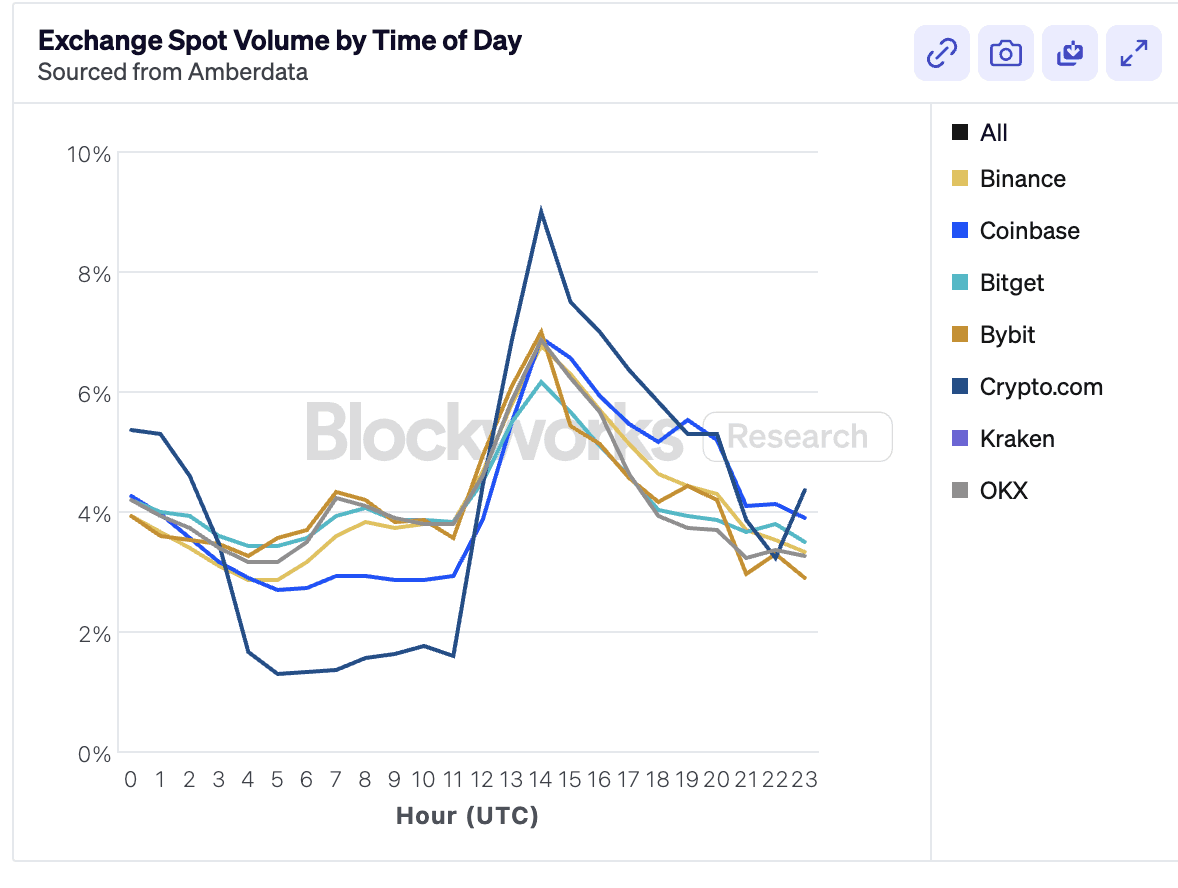
Source: https://blockworks.com/analytics/crypto-exchanges
Fogo proposes splitting the trading day into three 8 hour epochs aligned with global market activity: Epoch 1 (00:00 to 08:00 UTC) captures the Asia session, when Tokyo, Hong Kong, and Singapore are active, Epoch 2 (08:00 to 16:00 UTC) aligns with Europe’s day and the critical London, New York overlap, which is historically the highest volume period, and Epoch 3 (16:00 to 24:00 UTC) encompasses the U.S. afternoon and evening, where volumes remain elevated before tapering off into the Asia open.
Given the nascence of the network and proven success of Hyperliquid within the Tokyo region, it may be rational for Fogo to stick to just three data centers for the first 270 epochs, or 90 days.. As noted in earlier documents, it is incredibly important for Fogo Chain to have a “fall back” plan if any of the data centers / geographies go dark. The network reverts to global consensus if the validator set fails to agree on the next zone or if the current zone fails to achieve block finality. Global consensus is a protection against the regulatory & technical risks that come along with geographic centralization.
Following the first 90 days, the network and its validators should also keep an open mind on whether or not the additional regions are needed, or if it makes more sense to keep everything located within the three geographic regions. Adding additional geographies for validators over a long enough time horizon does not necessarily mean that the validators have to be jumping around more often, but it may be an effective way to decentralize the network simply by presenting more options in case there are glaring issues elsewhere. On the other hand, the network is already requiring high performance from its validator set and should attempt to maintain stability over time. To truly make this decision, the network, its validators and broader ecosystem stakeholders should remain committed to objectively interpreting real data and then move forward with the decision which is optimal for the network.
Protocol Incentives for Performant Validators
Aligning validators with the mission of building the most performant, trading focused blockchain will likely boil down to strong economic incentives and consistent communication across the set, ensuring that validator operators remain nimble and up to speed. Below are some ideas for how to economically incentivize validators to run the most performant clients at all time:
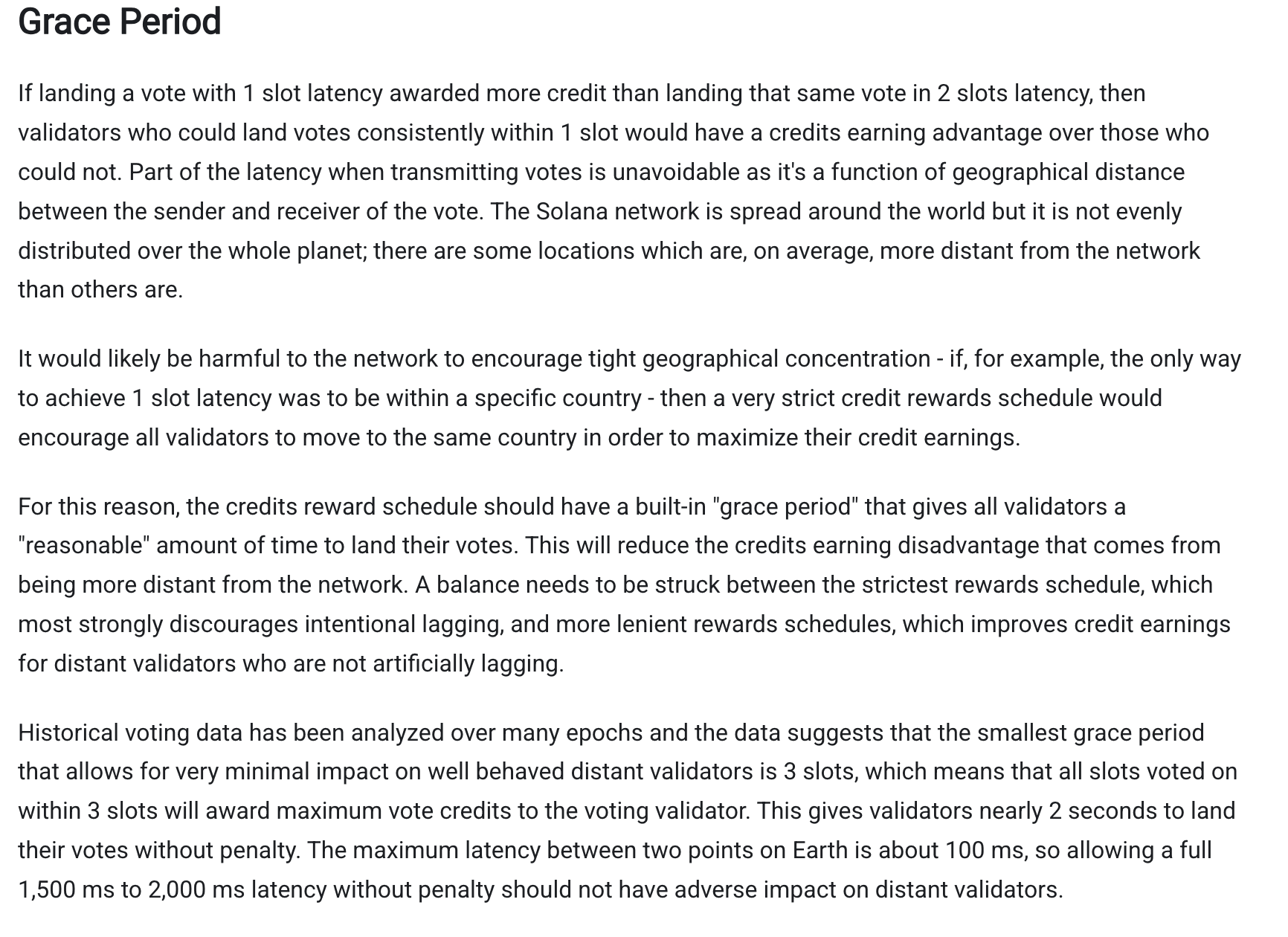
The above snapshot explains Anza’s proposed grace period for Timely Vote Credits, which is an attempt to keep latency as low as possible without encouraging colocation or geographic centralization. Fogo Chain is taking an approach reliant on colocation, such that they could forgo a grace period and require their validator set to vote within 1-2 slots to achieve maximum vote credits or to retain their delegation.
LSTs / Stake Pools
Third party working groups (stake pools) and LST protocols should continuously redelegate to the most performant validators, which will economically incentivize low latency and sufficient uptime in a more nimble manner than the foundation’s delegation program
Punishment for Missing Blocks
Missing transaction fees for blocks they miss when they are the leader
If Fogo Chain is to burn all of their transaction fees, then the network would have to implement an inflation reward multiplier similar to Solana’s TVC structure that would limit block rewards for non-performant validators
Social Penalties / Vote outs - especially important within a smaller validator set
Punishment for Running Outside the Colocation
Governance Framework for Including / Excluding Validators
Looking at the Hyperliquid validator set, their team has made the choice to utilize a permissionless but capped strategy - with 24 validators currently active. The 24 active validators are chosen by stakeweight as seen in the breakdown below.
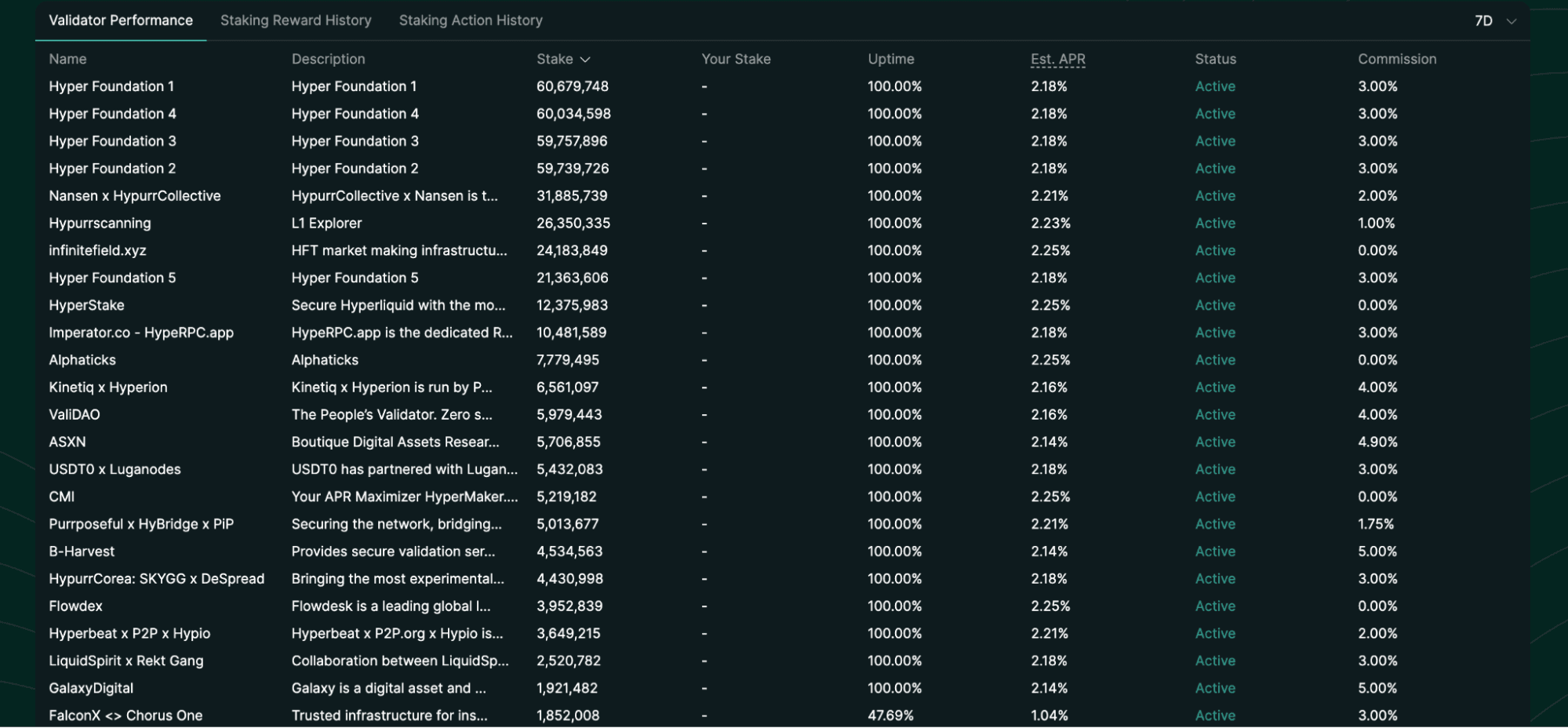
Fogo must consider the important balance of a sufficiently large validator set without adding unnecessary overhead to the network.
To do this we propose that anyone can permissionlessly join the network as a non-voting validator. In order to become a voting validator for a zone, you must be approved by the Fogo Validator Council. We suggest that the Fogo Validator Council operate via a /7 multi-sig and consist of 7 representatives: two technical operators, one researcher, two ecosystem reps, one representative from the Fogo Foundation, and one security specialist. The council should check to ensure the validator has demonstrated consistent uptime greater than or equal to the cluster average (vote credits, skip rate), a self-stake of 1m FOGO tokens, hardware requirements that meet or exceed the current set average, maintain industry leading security practices, and uphold a trustworthy reputation. The council should also administer the removal of any non-performing validator from the set.
Fogo Improvement Proposals (FIPs)
Purpose: FIPs are the formal mechanism to propose, discuss, and adopt changes to the Fogo protocol, validator set parameters, and ecosystem policies.
Process
Idea & Draft
Any community member, validator, or foundation delegate can draft a FIP.
Drafts include rationale, technical details, and expected impact.
Discussion
Drafts are posted to the Fogo governance forum and shared in validator/community calls.
Feedback is incorporated; drafts may be revised into a formal FIP.
Formal Submission
The FIP is submitted to the Fogo governance platform for on-chain signaling.
Proposals must meet minimum requirements (e.g., clear specification, no conflicts with active FIPs)
Voting
Validators vote with their stake weight during a defined voting period.
Ideally, we would like to see formal voting tool which is maintained by the foundation or a designated third party organization which would allow both validator to vote with their delegated stake, but also allow stakers who disagree with their validator can individually vote with their unique stake
Some FIP types (e.g., validator removal, inflation changes) require a supermajority threshold.
Enactment
Approved FIPs are implemented via protocol upgrade, multisig council action, or validator client release.
Enforcement mechanisms ensure non-compliant validators can be voted out or penalized.
Economic Design
Inflation is a crucial aspect for any proof of stake network, as it serves as a key incentive mechanism for a number of stakeholders; stakers, liquid stakers, DeFi users, validators, delegators, token holders, etc. Most mature and relevant proof of stake networks have wrestled with their inflation levels. Solana notably underwent a large community discussion following the introduction of SIMD-228, an improvement proposal which was seeking to alter the inflation schedule, moving from a hard-coded inflation schedule to a market based one which would alter issuance based on the amount of SOL staked.
Other networks such as Celestia and Near are actively cutting inflation in an aggressive manner, both recently cutting inflation down to around 2.5%. Inflation can be useful for bootstrapping early networks, serving as an incentive for stirring activity, but the rate and size of its decay, along with the terminal rate, is ultimately responsible for what the long-term supply will look like. Solana’s inflation is currently on track to decrease by 15% each year until a terminal rate of 1.5% is reached. That means it will take 15 years for Solana to reach its terminal inflation rate. We think given the revealed preference of not only Solana, but chains across the spectrum aiming for relevance in their own domains seeking to cut inflation, Fogo can take past lessons and apply them to their own inflation schedule with more aggressive decay to reach the terminal rate quicker.
Our Recommendation: We recommend an initial inflation of 6%, decaying 33% to 4% for year 2, and then reducing again by 50% to 2% terminal rate for year 3. However, a 2% terminal rate is arguably still high. We both anticipate and encourage the network to keep an eye on the terminal inflation rate, and maintain a willingness to reduce it further to 1%. We believe that this combination of relatively high initial inflation, quickly tapering off paints a clear picture for token holders and other various stakers. Quickly decaying inflation also ensures a more even distribution of tokens across both the short, medium, and long-term as opposed to what is seen on other networks where large holders are able to quickly separate themselves via compounding rewards.
There has also been revealed preference from users that higher inflation leads to less DeFi activity, as users can essentially capture the “risk-free” rate from staking. However, the amount of LSTs on both Solana and Ethereum have continued to increase inversely to the inflation rate of the network. On Solana, the LST penetration rate still remains relatively low, currently around 12%.
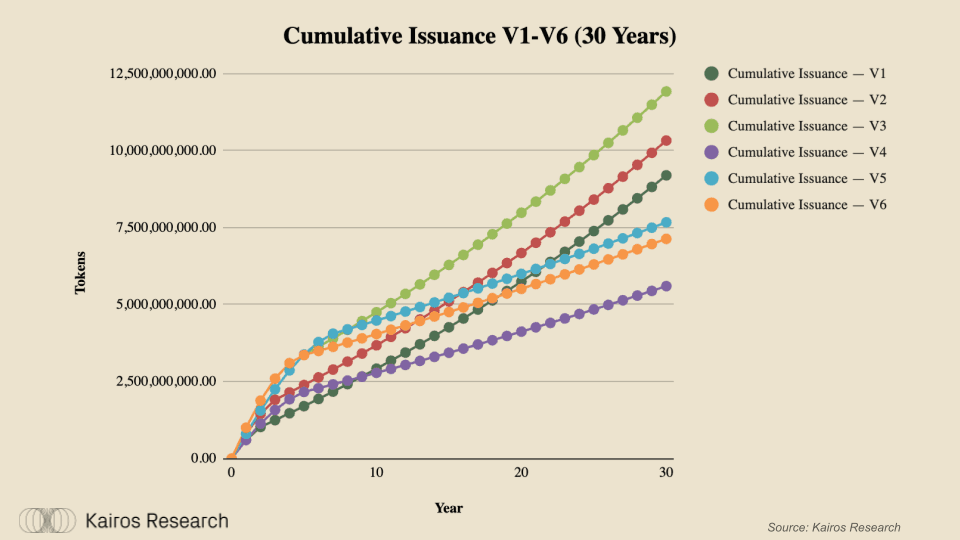
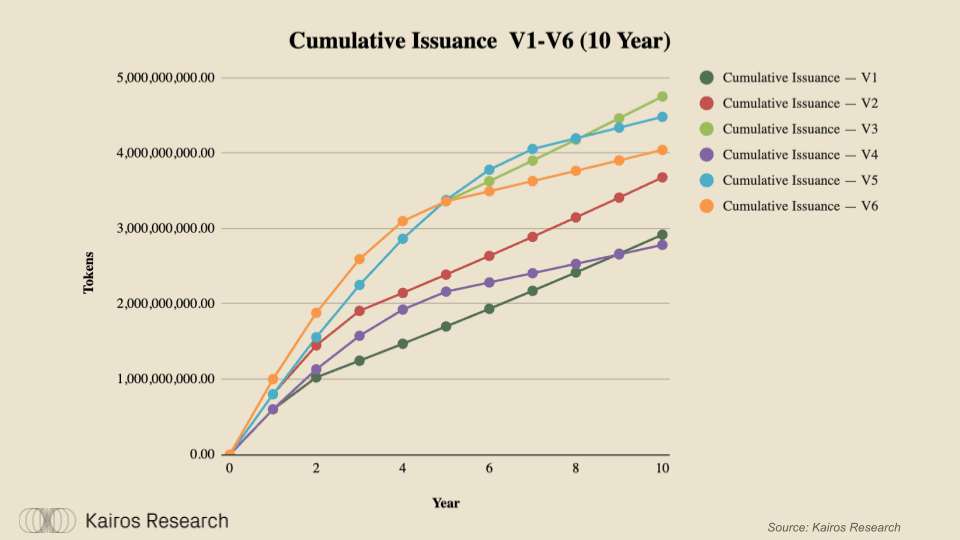
Link to our economic model where you can input: https://docs.google.com/spreadsheets/d/1q7-866GtD-Sl3ynVFInkqv5qcaSTaOq1Qu_gkMAz6zw/edit?usp=sharing
Initial Supply (tokens)
Start Inflation Rate (%)
Annual Step Down (pp)
Terminal Inflation Rate (%)
Validator Commission (%)
Stake Participation (%)
Fee Burn (%)
Commission
Validator commissions on rewards are also crucial as they serve as another key lever of how stake is distributed. Hyperliquid chose the route of letting validators set an initial commission, allowing them to decrease it, but never allowing them to increase it. This created an environment where validators sought to undercut one another in chase of stake delegation, creating a race to zero on fees. While this can ultimately be beneficial to delegators, it can create distorted outcomes for validators in the set. Due to external factors such as off-chain agreements for large amounts of stake, this empowers large operators with economies of scale to a competitive advantage thus leading to centralization risk. Additionally, that competitive environment drove smaller to mid-sized validators to work with teams orchestrating sandwiching via private mempools. This also created additional overhead for the Solana foundation, Jito, and other ecosystem contributors looking to combat these actors.
This then creates an environment where the operators with economics of scale can undercut other validators and attract more stake. Two of the best examples we saw on Solana for this were: Helius and Binance. Helius was able to attract stake by cutting their commission to zero, this allowed them to attract more stake and ultimately earn more leader slots, thus allowing them to build more blocks. Through this, Helius was also able to establish a greater validator presence and cross sell other products.
Binance on the other hand benefitted from its massive existing user base as the world’s largest exchange by both users and volume. This allows them to be the largest validator on Solana, and still be able to charge a 2% commission fee on their 13m SOL stake, representing over 3% of the total network stake. The data shows a clear picture, with stark differences on how the network’s top 100 validators earn their revenue, versus the lowest 100. The data is slightly outdated as it is from March, but still highlights the difference in how large validators vs small validators obtain their rewards.
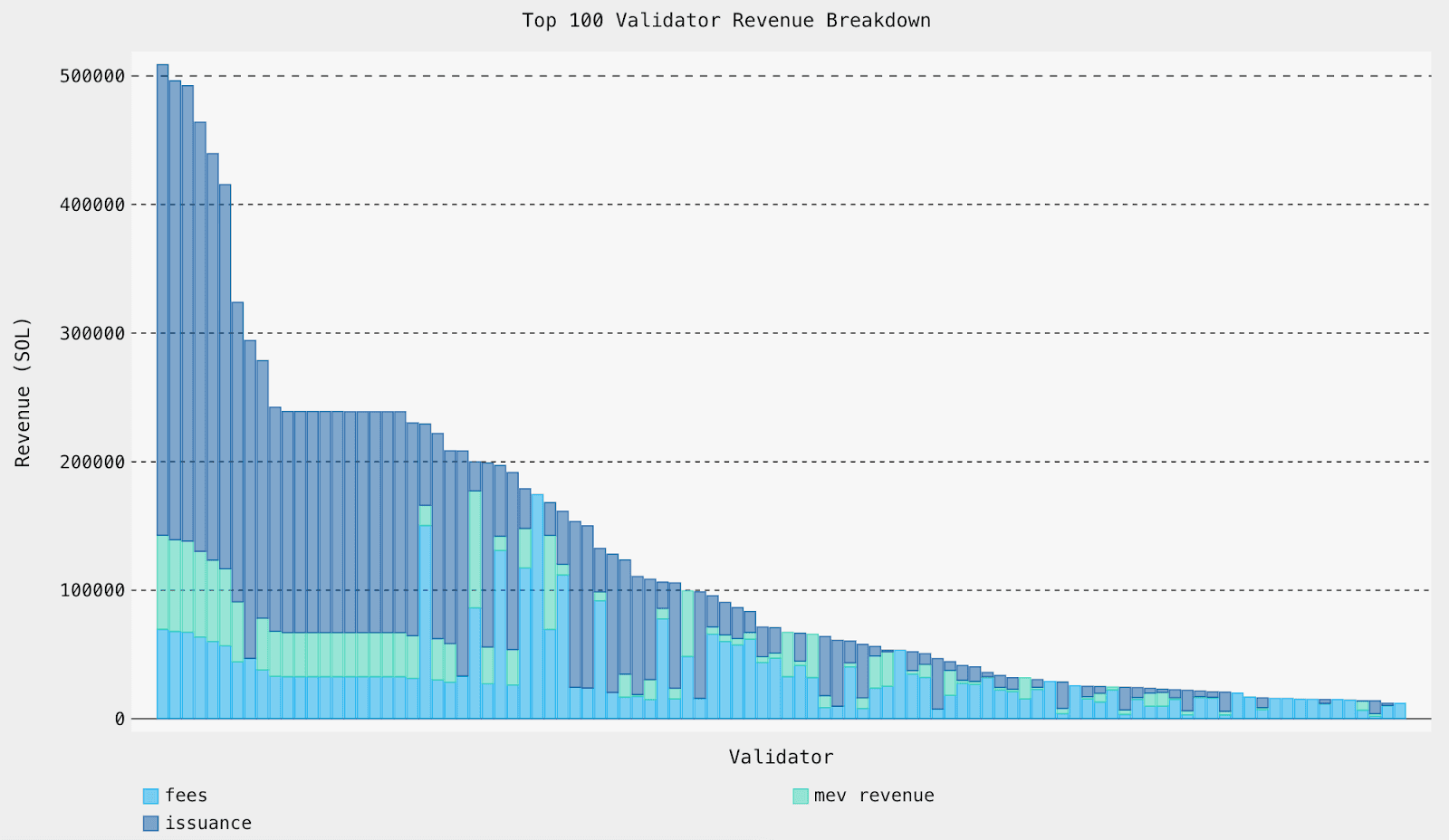
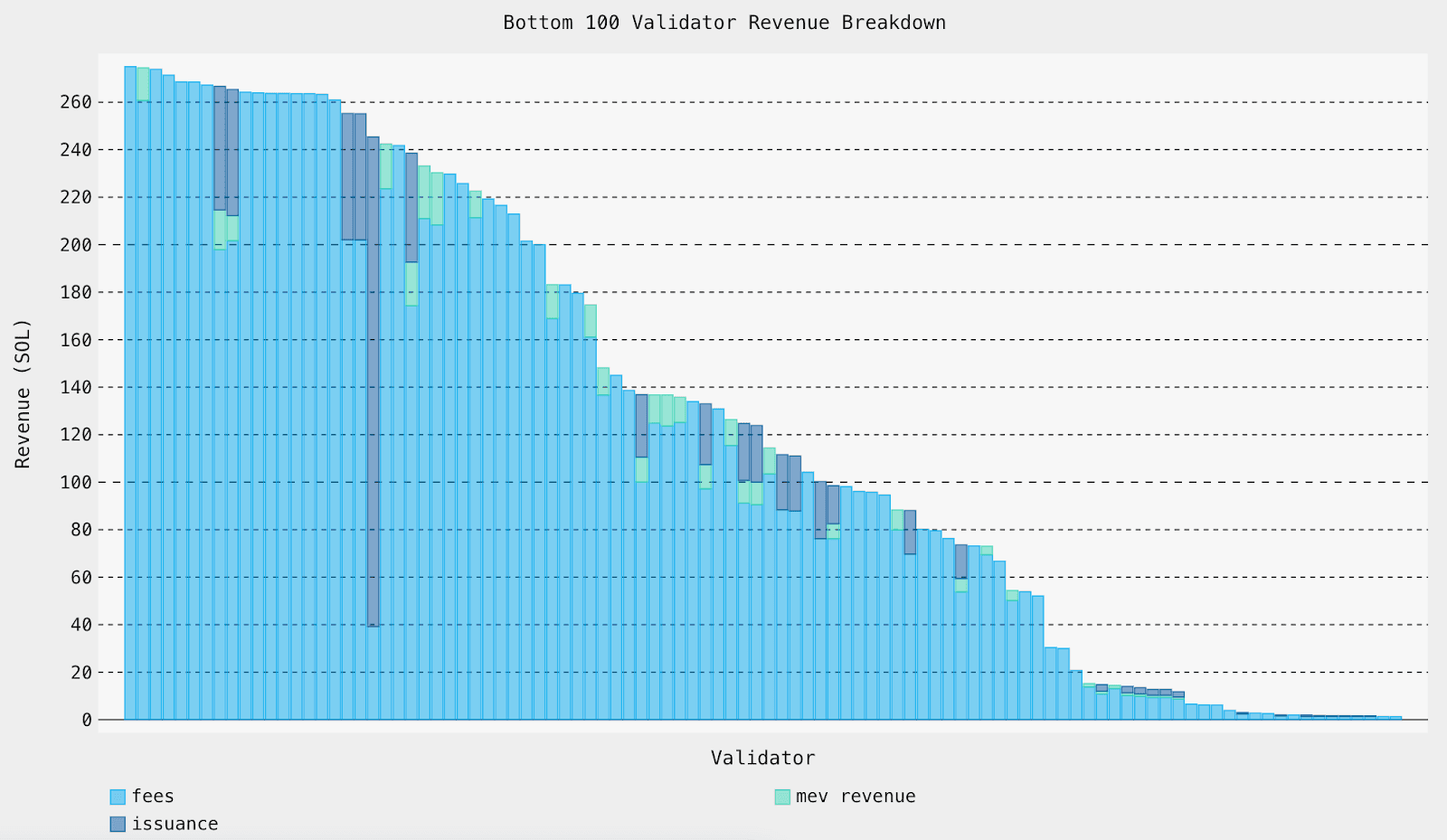
Source: https://github.com/mkq-volt/alpenglow_validator_analysis/blob/main/data/validator_profit.csv
Recommendation: We believe a uniform fixed commission rate of 10% across the validator set will give the network and its stakeholders greater control over the core economics of Fogo, allowing it to be collectively raised or lowered via governance depending on the needs of the network. Additionally, if possible, it would also be helpful to scrap Solana’s stake weighted leader selection, as this could still lead to a skewed reward system, where if one or several validators are able to secure offchain agreements for a material amount of stake, then the majority of slots would be filled by one or two validators. Instead a randomized equal distribution of slots across validators could be possible. This would also show very clear data around over/under performance given an equal amount of slots.
Alternatively, we understand this would go against the existing solana consensus mechanism, and also given Fogo block times are extremely fast there is less likely to be MEV vs what we are seeing on Solana with their 400ms block times. Additionally, if malicious MEV does appear prevalent on the chain, it would be easy to identify given the validator set size. Additionally, we understand that providing an equal amount of slots for each validator could minimize any incentive to attract more network stake through whatever means necessary.
Transaction Fee Revenue
With the validator set being sufficiently compensated through inflation, there is flexibility in what is done with gas fees on Fogo Chain. We believe that offsetting inflation through the burning of base and priority fees shows strong intention to drive value to FOGO & create a sustainable feedback loop. Outside of transaction fees, Fogo Chain would be able to accrue value back to their network through two other obvious methods:
Stablecoin yield, discussed in the next section
Enshrining an exchange (Ambient)
For example, Hyperliquid’s Hypercore forgoes charging gas fees because they can instead charge maker and taker fees on all transactions to avoid spam and state bloat. While zero gas is clearly an improvement to the trader UX, these maker and taker fees are also used to buy back HYPE and therefore offset inflation and directly accrue to validators / token holders. Allowing the application layer to be the fee generator seems to be a winning proposition and could be replicated very well if enshrining an exchange becomes a possibility. On the other hand, Hypercore is obviously very limited in the types of applications that can be built on top of it, so it’s unclear if zero gas fees would apply as successfully to a general purpose chain.
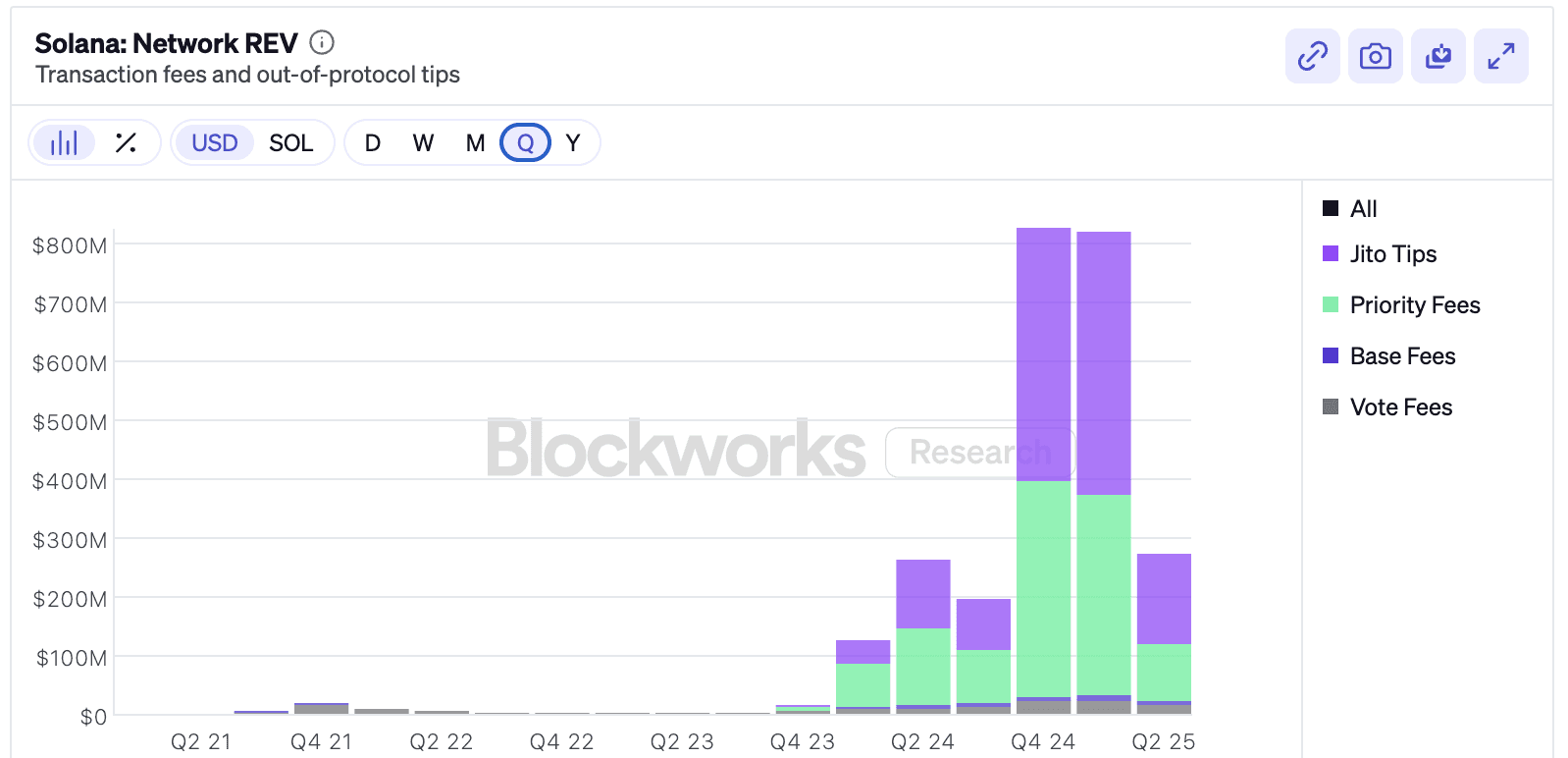
In direct contrast to Hyperliquid, Solana monetizes its chain through the burning of 50% of the base fees while passing the remainder to stakers. As we mentioned above, rewards to stakers should be thought less like dilution and more like a stock split - it is the validator commission that is dilutionary. A key issue there is that Solana passes 100% of priority fees back to validators and there was previously not a way to share pro rata with delegators, which means that in times of increased activity, validators were able to reap the benefits more than the chain itself. Looking at blockworks data, you can see that priority fees massively outsize base fees and these design choices make it more difficult to accrue value directly to the token.
Conclusion
We view this report as a starting point, not a final blueprint. The design choices outlined here will evolve as the network grows, and we welcome broad input to refine them further. Public feedback is open, and we encourage all stakeholders, validators, builders, and community members to share their perspectives to help shape the future of Fogo.
This article was prepared by a 3rd party.